Showing posts with label bikes. Show all posts

Tuesday, November 23, 2010

Falun velodrome visit

My bike club took a road trip up to Falun, in central Sweden to ride the new indoor velodrome built in a former factory space. As the volume of the space prevented construction of a proper 250m regulation 'drome, the group behind the project settled for a smaller 190m oval with relatively long straights and steeply banked (50 degrees) sharp corners. And by filling the space, (which was punctuated by columns) the site has no provision for any type of bleachers or public seating.

All these drawbacks made me somewhat skeptical of the project. But after participating in the weekend-long course, led by club member and local resident Alf, I have to say I am an enthusiastic supporter of the effort, and would love to see a similar development in Göteborg. Riding in ovals is far from boring when you have a fine indoor facility such as this, and it requires a good deal of concentration to avoid spills.

I did take a tumble, or rather ran over a fellow who took a tumble directly in front of me, so have experienced plywood-burns. The experience was nothing to get terribly worried about, and will absolutely not prevent future endeavors on the track.

The visit did cause me to evaluate the total costs associated with having an indoor velodrome, which can be broken down into three broad categories: 1) the space, 2) the velodrome itself and associated costs (showers, bicycle maintenance and storage), 3) maintenance of the facility.

Of course, in the long run, 3 is going to be the biggest cost. The energy required to heat this immense volume is frightening to think about. As for initial costs, 1 vastly outstrips 2, especially if one is considering a vast span (no columns to disrupt views) and seats for a public. There is great architectural potential in an arena project, but the velodrome would most likely have to double up as a handball or basketball court, or ice rink, comprimising the interests of cyclists.

By reusing an existing facility, as they have in Falun, costs for 1 have been eliminated, allowing the much easier financing of 2. As for 3, hopefully the development will be such a great success that those operating costs will be covered by the site itself in a couple years. Time will tell.

One could skip 3 by proposing an outdoor velodrome, or a velodrome in an unheated shed, or simply under a roof, but that may not be such a popular solution. And in our post-industrial society, we are not lacking in vast empty factory buildings...

Friday, October 15, 2010

Bridgestone MB-6 Project, Part 2


I visited the powder-coater with the bare frame this week, and was a bit taken aback by their new pricing. Really, the price is reasonable considering the work it takes, and to tell the truth I haven't been very satisfied with the work done for 200 kr. 800 kr, the current asking price, includes bead blasting and clear coating, luxuries previous junk bike projects have gone without. This is a vanity paint job more than anything, since it's not covering up any frame modifications. But the original paint was in such bad shape, I think I'll go ahead and do it. I'm going to blast the frame myself though, and save a bit on the total cost. They even had a pink, RAL 3015, which seems a popular color for bikes.

It seems a shame to spring for a new paint job without doing any frame modifications. The most obvious route, since it's going to be a singlespeed anyway, would be to put on some track ends. That way I'd avoid the trouble of gimmicky chain tensioners and whatnot. Still, I have a feeling this bike will live to experience another build, and I may want that derailleur hanger in the not-so-distant future. Also, the dropouts feature a couple fender/rack mounts, which will probably come in handy, and which are generally lacking from track ends if you don't drill and tap some of your own.

Another nice feature for a future build would be down-tube shifter mounts. These would add flexibility to any geared arrangement with derailleurs, and would allow the use of cheap and plentiful friction shifters either on the frame or on the bars. But again, the current build plan is to go singlespeed, and exposed and unused shifter bosses are even worse than exposed and unused canti-bosses, in my mind. So I think we'll forgo any additions or removals from this frame.

Is this frame really worth the trouble I'm putting into it? Of course I think so, for a number of reasons. Since I salvaged the frame, and am building the bike largely with the detritus of parts bins, my total cost won't be anywhere near that of a new bike, especially of the quality of this one. I believe any sort of adaptive reuse is a better solution for an old bike than the landfill, but there are particular bikes which represent especially good candidates for these types of projects. Road bikes from the 70s, 80s, and early 90s are widely appreciated. Quality, especially mid-market and up, was particularly good, industry standards still in use today were solidifying, and the geometry favored by builders was appropriate for a number of applications beyond that of road-racing.

Perhaps less appreciated today are the mountain bikes of the early 90s. There was a golden window, when mountain bikes were at the height of their popularity, that a number of factors came into play:

1 Geometry was more racing-oriented than that of most mountain bikes that came before, which means these bikes ride well over a variety of terrain. Also, they were not yet "suspension-specific", meaning the gap from bottom of the headtube to the tire falls is reasonable-appearing with normalish tires and fenders.

2 Standards in use today became firmly established: gone were the oddball U-brakes behind the bottom bracket and E-stays. Also, modern headset sizes (threaded 1", threadless 1 1/8") were common. Watch out for oddball headsets though! A good shop can help with things like facing a JIS-standard fork for industry standard races, but stems for threaded 1 1/8" forks or threadless 1" forks or anything 1 1/4" are hard to come by!

3 Taiwanese construction was established and relatively good by modern standards. Preferable exchange rates meant Western countries could buy relatively high-quality frames at low cost. Tube sets of complete double-butted chromoly and nice investment cast fittings were the norm even on mid-level bikes like this one. The aluminum bikes that stormed the market a few years after these are fine bikes, but they can't be as freely modified or repaired as bikes with steel frames.

4 Suspension forks hadn't yet entered the mainstream at the mid-level pricepoint, which automatically made these bikes a better all-around value than those that followed. Not having a suspension fork reduces the overall complexity of modifying these bikes for other use, as you don't have to spend time searching for finding out-of-production replacement parts. Fortunately, there are plenty of rigid replacement 1 1/8" forks available for those stuck with an obsolete fork.

The Bridgestone frame I am working on with this project benefits from all of the above. 26.2mm seatposts don't grow on trees, but otherwise almost everything on this frame is relevant today. The 1" threaded fork means I can pick from a variety of interesting stems, and cantilever brake bosses open up the world of modern and vintage cantis and V-brakes.

All that being said, it's not a lightweight:

Frame: 2342g
Fork: 882g
(with original paint)

Wednesday, October 6, 2010

Bridgestone MB-6 Project, Part 1

I love junk bike projects. Taking a bunch of old, abandoned parts and making something new, useful, and maybe even beautiful out if it can be a lot of fun. Of course, working with nice parts has it advantages, but the challenge presented by a pile of junk is unique.

This 1991 Bridgestone MB-6 may not be the finest salvaged bikee out there, but it is a tigged-in-Taiwan double butted Tange Chromoly frame with pretty decent geometry. It's actually pretty similar (probably identical, save for the size) to my MB-5, and like that bike, I plan to limit this build to a single gear. I perhaps too-hastily built it up for my cousin visiting last month, and it barely survived the 100km gravel race she rode it in. My main problem in that build, besides chain tension, were the frozen-in-the-frame bearings and stem wedge. Carrying it home from the bike club, I ran into a fellow with a high-pressure hose cleaning out the tram turnouts in the street, and had him clean the mud off of the thing. After about an hour at Veloform today, I left with a bare-naked frame and fork, ready for powder coating.

A local powder coater has had pretty reasonable rates for bike frames, which encourages one to experiment or modify a frame more than one would without a cheap and effective way of covering the frame up again. For example, my fixed-gear bike is a salvaged road bike with brazed-in track ends, replaced brake bridge, and removed down tube shifter mounts and brake cable stops. My wife's commute bike is an old mountain bike with down tube shift bosses added. I don't think I'll be doing any frame modifications to this bike, but it certainly needs paint.

Walking home from the shop today with the frame I ran into Patrik, carrying a repaired Surly Cross-check. We compared frame weights a bit, and can only conclude that this frame is a boat anchor. Of course, one only has to consider the 26.2 seatpost to realize that the tubes are a bit thicker than bike snobs may be used to...

But like I said, good geometry, a solid frame and rigid fork. It should be a fun bike.

Sunday, October 3, 2010

Friday, October 1, 2010

Clen-tador

The NYT chimes in on the increasingly complex physiological and pharmaceutical knowledge cycling fans are expected to keep track of. But they fail to link to the leading source of doping chatter, the Clinic Forum over at cyclingnews.com.

Wednesday, September 29, 2010

A sensible trail bike

In a previous post I commented that cyclocross bikes have certain shortcomings enforced by the UCI. I myself have enjoyed a cyclocross bike for a number of years, moving to Europe with one as my sole bike over ten years ago. As it has since seen a number of stablemates join it in my collection here, its purpose has been somewhat in question. This seems the fate of any do-it-all type bike that is gradually supplanted with others that better fill this or that niche. I already have another hybrid in use as a commute bike, so the Bianchi has become my long-ride trail bike project.


Here it is, pictured in the middle of a 42km mixed-terrain ride I did yesterday. The 38mm tires offer plenty of volume for rough trail surfaces, though as a rider you have to be more careful than you might riding fat 55mm tires. The cassette and chainring combo provides a broad gearing selection, and the funny handlebar offers plenty of hand positions with good control over the bike.

The ride was maybe 60% trails and gravel, with the remainder well-maintained asphalt, the latter primarily in a strong headwind. The bike performs well as set-up in most of these conditions. Admittedly, I sometimes wished for the comfort, predictability, and braking performance of my mountain bike, and on the ride home I maybe would have preferred my road bike, but I would never have taken either on the entire route.


Bike route 715712 - powered by Bikemap 

Thursday, September 23, 2010

Thoughts on cyclocross bikes

"Hybrid" bicycles have long suffered the derision of the fancy-bike set, with the reasoning that they "can't do all things equally well." If by "all things" one includes fast road club rides and ledge-bombing off-road descents, this is a fair complaint.

A simple equation for determining the appropriateness of a bicycle for a given terrain would be something like "tire width" x "gearing" / "rider fitness and skill". "Mountain bikes" tend to have much wider tires, around 50-60mm, and much lower gearing than "road bikes". The remaining differences, one can argue, are trivial, or related more to either tire width or gearing than to the terrain itself. For example, "road" brakes accommodate only "road tires" with little clearance for mud, fenders, or fatter tires. Rider fitness and skill are important to consider as well, however, because particularly fit or skilled riders can accomplish much more with a given bike than the bicycle itself might suggest.

Hybrid bicycles have always tried to run the middle ground, with broad gearing and mid-width tires, which has been a reasonable set-up for indeed most of the riding public riding most roads and trails together with most other people. The sneering from the bicycle community originates mainly in component snobbery and expectations about particular types of bikes in particular terrains. The problem really comes from the component manufacturers' side, which has steadfastly refused to produce quality parts not required for specific types of competition. Thus, a paucity of appropriate tires, and clumsy or aggressive mountain bike drivetrain parts have been part and parcel of the hybrid specification.

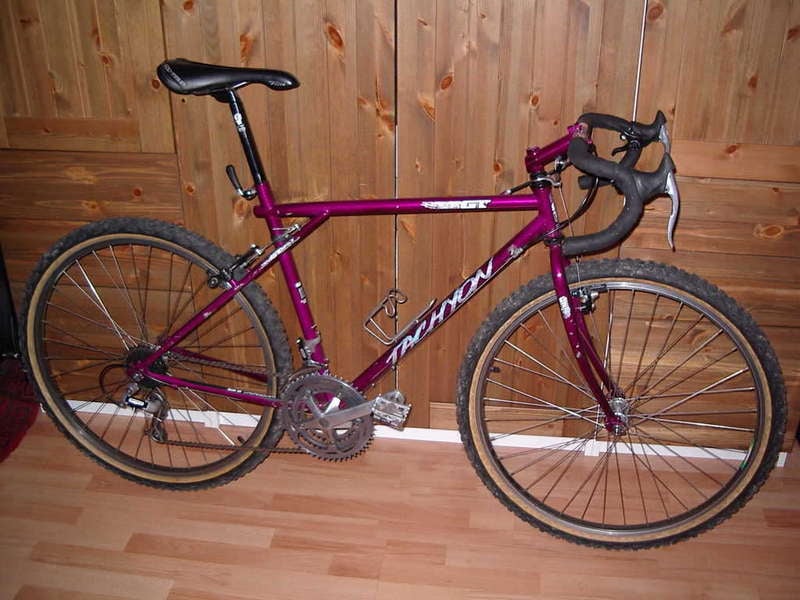
Some hybrids are arguably more successful at bridging the gap, such as the short-lived and rare Specialized Rock Combo and Bridgestone XO-1. Both of these bikes pursued the successful route of using 559mm rims, taking advantage of this size's comparatively wide variety of tires. The Specialized, using MTB drivetrain parts, achieved lower gearing, while the XO-1, using lighter road parts compromised with the acceptable low of 34/28. Both also abandoned the limiting flat bar in favor of more "road" bike style bars with multiple hand positions. Tire availability is really the most important factor in spec-ing bikes like this. Drivetrains and gearing are changed easily enough, but with canti-bosses fixed on the frame, changing rim diameter to match tire availability is another matter. Perhaps the most salient example of this problem was the doomed GT Tachyon and its proprietary 700D tire size. Without any replacement tires available, those bikes are sitting pretty useless now.

But things have changed in the past ten years. The popularity of "29-er" mountain bikes has meant a burst of variety on the wide-end of of the 622mm rim diameter tire selection. Tubular tires are gaining popularity even for smaller wheeled mountain bikes (more a curiosity than anything relating to the theme of this post) and component manufacturers are starting to realize the potential for wide range gearing systems, like SRAM Apex. Perhaps most importantly, disc brakes, despite some of their drawbacks, have divorced the rim diameter from the braking equation. This is actually huge news, as it allows one to select tires based less on rim diameter than appropriateness for the intended use. For example, a rider with a hardtail mountain bike can build up an extra set of wheels using 622mm rims to utilize the wide variety of 700x23c tires available in this size. Bottom bracket height still needs to be considered, but as I mentioned before, this is trivial in comparison to tire selection.

OK, so what about cyclocross bikes? These bikes have long been seen by the bike crowd as acceptable hybrids. For mountain bikers, they look an awful lot like a road bike, while roadies see them as a form factor they're comfortable with, just with fat knobby tires. The thing is, of course, that cyclocross is a discipline, with very specific (and arguably arbitrary) rules concerning componentry that cyclocross bike manufacturers have to respect. Despite the fact that the vast majority of cyclocross bikes sold (and, according to reports from Eurobike, [and, one could gather, from this widely circulated cartoon from last year] a lot will be sold this year) will never see cyclocross competition, the buyers of these bikes will have to endure these restrictions as they use their shiny new steeds for commuting or be-fendered winter road riding.

To start with we must address the discipline. Cyclocross racing has about as much to do with trail riding as criterium races have to do with road riding. The arbitrary limitation of tire width to 35mm and the ban on disc brakes has limited the utility of these bikes for consumers wishing to use these bikes for more real-world type conditions. With the new season upon us, of course, the tires have been further limited to 33mm, while the ban on disc brakes has been lifted.

The tire issue is problematic. For those of us with monster-cross builds, or similar 700c hybrids, the issue of quality tire availability in the 35mm-50mm gap has been of serious concern. I'm currently running wire-bead WTB Interwolf 38s, but would love a set of foldables. With the UCI ban on 35s, however, and manufacturers catering primarily to the racing crowd for quality parts I hardly see this becoming a reality in the coming years.

The liberal stance on disc brakes is more promising. As I mentioned before, one of the great benefits of this type of brake is removing the brake from the rim diameter equation. With long-reach caliper brakes, the center bolt of frames intended for 700c wheels have accommodated the suddenly-popular-again 650b wheel size. While at first I was skeptical about the need for this in-between rim size, I can see a greater utility in the tire size when frames are equipped with disc-brake mounts. For example, a cyclocross bike designed for 33mm tires and disc brakes could probably accommodate a much wider 650b tire, even a knobby. This can only be considered a good thing, even if it kind of leaves out all of us with full bike stables and nary a disc brake to be seen.

Friday, September 17, 2010

Exciting times for drop bars

There was a time, not so long ago, when the handlebar selection of your typical high-end shop consisted of road drop bars (25.8-26.1 mm clamp) and flat 5 degree mountain bike bars (25.4mm clamp). Maybe there would be a pursuit or TT bar laying around, and if your shop was particularly cool, a Nitto moustache bar.

Nowadays handlebar variety has exploded, and with it the simple characterization of bikes into MTB/road categories has fallen apart. Sadly, the old WTB dirt drop bend is no longer available, but there are a wide variety of different bars that fall somewhere in-between your typical drop and your typical flat bar. Even flat bars have gotten interesting thanks to Salsa (17 degree flat bar) and Jitensha studios.

Sadly, though, transmission and braking component manufacturers haven't really kept up. Road-derailleur-compatible flat bar brake/shift levers are easy enough to come by, but the variety of brake levers for operating mountain-style brakes beyond cantis on drop bars has been sparse. May Tr!ckstuff be praised!

Photo from cyclingnews.com.

This clumsily-mounted chunky widget converts the mechanical pull of your typical drop-bar brifter into hydraulic-line disc brake actuators. More useful for sure than those hard-to-find Magura set ups that only work with their cant-post hydraulics.

Even more challenging than braking from drop bars has been fitting a Rohloff hub shifter, designed for 22.2mm bars. But Mittelmeyer can help you with their reasonably-priced custom shifter.

So it is definitely time to start experimenting with drop bars off road.

Wednesday, September 15, 2010

Miche Loose Cassette Cogs


As an avid cyclist I've been aware that loose cassette cogs are available from Shimano, but have never given them much thought. This display, at my local shop Veloform, caused me to reconsider the possibilities presented by custom cassettes. These cogs, available from Miche, are suitable for 7-9 speed Shimano cassettes, depending on the spacers used, and are available with grooved, locking top cogs in up to 16t. Considering the 8 speed cassettes I use on all my geared bikes are currently available primarily in configurations starting with an 11 t cog, (yes,there is a very nice 13-26 still around) this opens up the door to a variety of interesting gearing options. My favored 12-28 XTR cassettes are long gone (though IRD makes a similar) but now approximations can be made by hacking existing cassettes and replacing top or bottom cogs.

That the loose cogs stop at 29 may seem a problem to those running mountain bike rear derailleurs, but this can easily be remedied by starting with a stock 11-32 (or 11-34 9 speed) cassette and replacing the top cog with a more sensible 13 or so. I plan to do just this with my monster cross build, paired to a 34/48 up front.

I suspect a lot of folks out there with 10 or 11 speed cassettes are running in essence 8 speed drivetrains, as those tiny top cogs aren't likely to see much action if one doesn't live in a place with long, straight, 8% descents or run incredibly compact chainrings. Reconsidering the composition of the cassette beyond what the manufacturers sell is maybe the single biggest, easiest component improvement you can make to your bike, and displays like the one pictured above present this fact to the consumer in a very approachable and inspiring way.

Hack your cassette!