This article makes some interesting points about engineering and product design, concluding that frugal design and engineering have a lot to contribute to both the developed and developing world. Curiously, the article skirts the ideas of appropriate technology or the Long Now foundation.
At the same time, I read in Newsweek that there will be 5 billion mobile phones in use next year, out of a global population of 7 billion. Considering the number of people either too young or too old to use mobile phones, that is a truly incredible statistic. Of course, the majority of those carrying mobile phones around the world use them for little more than calling or sending text messages. Phones like the Nokia presented in the first linked article offer these services and little else.
This is a frustrating use of resources. Sometimes I felt like I was the last person in Sweden to start using a mobile phone five or so years ago, but I couldn't really be convinced of the utility of carrying a device that could only make (expensive!) phone calls. When I bought my first mobile phone it had a decent camera on it, which was useful for note-taking, but I also very quickly learned to love Opera Mini, which gave me access to almost the entire internet through GPRS. This was a more monumental event than gaining access to the internet for the first time in college. Back in '96, the internet had the tiniest fraction of the world's information searchable, but by 2006 it was a different story altogether.
The point is, every mobile phone has the basic functions to allow access to the internet. They are by their very nature telecommunication devices, so network access shouldn't be a problem. They have displays, even if they are rudimentary, that can present text. And they have some sort of input device, a keypad. The internet is now a great depository for all manner of sounds, video, and images, but it is still largely driven and organized by text. That 5 billion people next year can have access to that information from almost anywhere is truly revolutionary. But can these simple phones access the internet? Are they provided with the software to make it possible? I certainly hope so.
Smart phones are great, but I think these not-so-smart phones could be truly earth-shattering.

Friday, October 8, 2010

Wednesday, October 6, 2010
Bridgestone MB-6 Project, Part 1
 I love junk bike projects. Taking a bunch of old, abandoned parts and making something new, useful, and maybe even beautiful out if it can be a lot of fun. Of course, working with nice parts has it advantages, but the challenge presented by a pile of junk is unique.
This 1991 Bridgestone MB-6 may not be the finest salvaged bikee out there, but it is a tigged-in-Taiwan double butted Tange Chromoly frame with pretty decent geometry. It's actually pretty similar (probably identical, save for the size) to my MB-5, and like that bike, I plan to limit this build to a single gear. I perhaps too-hastily built it up for my cousin visiting last month, and it barely survived the 100km gravel race she rode it in. My main problem in that build, besides chain tension, were the frozen-in-the-frame bearings and stem wedge. Carrying it home from the bike club, I ran into a fellow with a high-pressure hose cleaning out the tram turnouts in the street, and had him clean the mud off of the thing. After about an hour at Veloform today, I left with a bare-naked frame and fork, ready for powder coating.

A local powder coater has had pretty reasonable rates for bike frames, which encourages one to experiment or modify a frame more than one would without a cheap and effective way of covering the frame up again. For example, my fixed-gear bike is a salvaged road bike with brazed-in track ends, replaced brake bridge, and removed down tube shifter mounts and brake cable stops. My wife's commute bike is an old mountain bike with down tube shift bosses added. I don't think I'll be doing any frame modifications to this bike, but it certainly needs paint.

Walking home from the shop today with the frame I ran into Patrik, carrying a repaired Surly Cross-check. We compared frame weights a bit, and can only conclude that this frame is a boat anchor. Of course, one only has to consider the 26.2 seatpost to realize that the tubes are a bit thicker than bike snobs may be used to...
But like I said, good geometry, a solid frame and rigid fork. It should be a fun bike.
A Whole Chicken
Every so often, once a week to once a month, I'll take advantage of a good offer and buy a whole chicken. I could roast it whole, of course, or cut out the back and roast it flat as Bittman advises. Usually, though, I butcher it and take it through the following steps:
1 Breasts get used for fajitas or stir-fries, or are maybe marinated and grilled, and sliced and served alongside heaps of veggies and starches. At any rate, there are just the two of them, and they're usually not that big when I get them off of the whole chickens on offer here. But they'll provide the animal protein for a family meal at any rate.
2 Drumsticks get separated from the thighs and, and these together with the wings (and oysters, if I remember to dig them out) are marinated and roasted and served whole, or pan-fried, or thrown into a simple chicken stew. More flavor, and fat in these pieces, though they're filled with those cumbersome bones.
3 The carcass is really what we're working towards here. The other parts can get bought and used already prepared, but the carcass is special, especially in a country where canned chicken broth is unheard of. Here you're stuck with salty, suspicious bouillon cubes or doing it from scratch. I keep a big yogurt bin in the freezer I periodically fill with vegetable trimmings: the ends of onions and carrots and celery, and when I've got a chicken carcass (or back) to work with I throw it (trimmed of fat and skin) in the stock pot along with whatever's in the freezer. I usually get enough stock from this process to make a pot of soup and a batch of risotto.
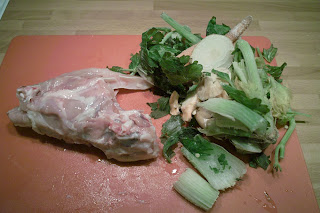
There's nothing new in any of this, of course, but it does require a little planning ahead and a bit of time on the part of the cook. We're not a vegetarian household, but that doesn't mean we don't respect the animal or can't try to make the most of it while limiting our intake of animal protein. Making a chicken last three or four meals is just part of that philosophy.
1 Breasts get used for fajitas or stir-fries, or are maybe marinated and grilled, and sliced and served alongside heaps of veggies and starches. At any rate, there are just the two of them, and they're usually not that big when I get them off of the whole chickens on offer here. But they'll provide the animal protein for a family meal at any rate.
2 Drumsticks get separated from the thighs and, and these together with the wings (and oysters, if I remember to dig them out) are marinated and roasted and served whole, or pan-fried, or thrown into a simple chicken stew. More flavor, and fat in these pieces, though they're filled with those cumbersome bones.
3 The carcass is really what we're working towards here. The other parts can get bought and used already prepared, but the carcass is special, especially in a country where canned chicken broth is unheard of. Here you're stuck with salty, suspicious bouillon cubes or doing it from scratch. I keep a big yogurt bin in the freezer I periodically fill with vegetable trimmings: the ends of onions and carrots and celery, and when I've got a chicken carcass (or back) to work with I throw it (trimmed of fat and skin) in the stock pot along with whatever's in the freezer. I usually get enough stock from this process to make a pot of soup and a batch of risotto.

There's nothing new in any of this, of course, but it does require a little planning ahead and a bit of time on the part of the cook. We're not a vegetarian household, but that doesn't mean we don't respect the animal or can't try to make the most of it while limiting our intake of animal protein. Making a chicken last three or four meals is just part of that philosophy.
Tuesday, October 5, 2010
Sunday, October 3, 2010
Pastry Cutter Improvement
I've been making a lot of biscuits lately, partly inspired, I guess, by Bad Bart or whatever The Dude II was called in Crazy Heart.
"Oh yeah, biscuits. Need to do those more often."
By the way, why the cream of tartar? I'm guessing he was using some antiquated recipe before pre-blended baking powder was available? At any rate, I don't use cream of tartar, though I have found a source in Sweden: Curry House, in Haga has it in stock. I forget if they call it vinsten or cream of tartar, but at any rate you can't get it at the pharmacy anymore.
To incorporate the butter and flour in biscuits, or for pie crust, I've been using my stand mixer for the last number of years, because it's there and it works, and because I hated my pastry cutter. Maybe I've been using it wrong, but I didn't like the way the handle rotated in my hand, and the protruding nut on one side always dug into my skin. So the pastry cutter languished in a drawer, and every time I set about making a little batch of biscuits I'd fire up the Hobart, which seems like overkill.
I tried replacing the bolt with some stainless screws I had laying around from an earlier project, but the hole for the through-bolt was so big the screws didn't bite very well. So I decided to make a new handle.
I had some ash laying around, so I got out an appropriate knife, cleaned up its edge, and got whittling.
 A little 240 sandpaper later and the handle was ready. I cut it off and rubbed some canola into the grain, followed by some beeswax, and then used the stainless screws to fasten the handle into the pastry cutter again.
 The whole process was done before my potatoes finished boiling. And it didn't cost me a cent. And it will make using the pastry cutter a whole lot more pleasant. So why did I put it off for so long? These sorts of little projects can make life easier and more enjoyable, and aren't exactly a nuisance. And are in every way sustainable: I have repurposed a tool I found lacking rather than replacing or discarding it. This project will moreover enable me to use a simple hand tool over a complex and energy-demanding power tool when appropriate.
Fixing a broken or lacking tool is the sort of thing that should be second nature to us, but seems more and more to be a thing of the past. That I should be blogging about this mundane repair is on the surface ridiculous, but I believe we need to think more in terms of making do with what we have.
Oct. 5 update: I furthered refined the handle by rounding the hard edges visible in the above photo.
Ronde van Retaard Pictures
Hallisar has finally posted his enormous batch of pictures from this year's Ronde van Retaard!
Friday, October 1, 2010
Clen-tador
The NYT chimes in on the increasingly complex physiological and pharmaceutical knowledge cycling fans are expected to keep track of. But they fail to link to the leading source of doping chatter, the Clinic Forum over at cyclingnews.com.
Subscribe to:
Posts (Atom)